

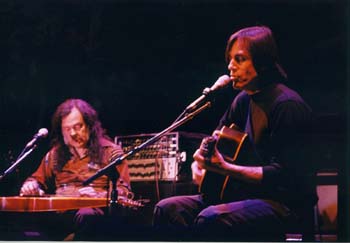
Apologies for this grainy photo of Rodriguez and band; the only one we took prior to being informed of the artist’s “no photos” policy
There’s nothing like being the subject of an Academy Award-winning documentary to thrust a person into the public eye. The brief rise, decades-long lapse into obscurity, and subsequent rediscovery and rejuvenation of Sixto Rodriguez are all well-chronicled in the 2012 film “Searching For Sugar Man.” The Detroit singer/songwriter was thought to have had a promising career ahead of him, releasing two albums (“Cold Fact” in 1970, and “Coming From Reality” the following year) before a combination of bad management, lack of label support, and his own personal demons caused him to disappear from view – at least in this country.
Copies of his albums somehow made their way to South Africa, however, where Rodriguez’s politically-charged commentaries on urban life resonated with the growing anti-apartheid youth movement there. He became hugely popular, merely on the strength of these two albums, although nobody knew a thing about him. And, according to the documentary, he never made a dime off of all the thousands of albums sold in that country.
Life changed dramatically for Rodriguez in the late 1990’s, when he was rediscovered through the persistent efforts of a small group of diehard South African fans, who were also involved in the music business. A series of triumphant, sold-out concerts in South Africa eventually led to the making of the “Sugar Man” movie, the publicity from which has caused his current U.S. tour to be one of the hottest tickets of the year.
Rodriguez took the stage at the Fitz to a standing ovation from the sold-out house. He looked frail, being supported by two young women (his daughters?) as he walked tentatively to the mike stand, where his unnamed lead guitarist plugged in his guitar for him. Dressed in black, with a wide-brimmed black hat hiding his face, it was difficult to get a sense of his well-being from our seats in the balcony. However, his voice was strong and assured as he sang the opening song, “Climb Upon My Music.” Like many of the offerings that evening, the song sort of trailed off at the end, with the three-man band ending at different times. It’s not clear how long this particular group of musicians had played with Rodriguez, but one got the sense that Rodriguez is an intuitive performer, like Dylan, and it takes time to pick up his subtle musical cues and gestures. The flow and pacing of the set was halting and tentative, too, as there was always a pause between songs while Rodriguez and the lead guitarist conferred, generally followed by the guitarist calling out instructions to the bass player and drummer. Set list, anybody?
A measure of Rodriguez’s triumphant return to popularity is the newly-recorded cover of his tune, “I Wonder,” by Alabama Shakes front woman Brittany Howard and Ruby Amanfu. Rodriguez’s own rendition of the song was an early set highlight, drawing a huge reaction from the crowd. From there, he played the first of several surprise covers, a jazzy rendition of “One Of Those Things.” Rodriguez’s vocal was subtle and self-assured on the Cole Porter classic.
“Inner City Blues” was next, this being Rodriguez’s own composition, as opposed to the more famous and entirely different song by the same name by fellow Detroiter Marvin Gaye. The song plays a pivotal role in the rediscovery of Rodriguez in the movie, with its reference to “Met a girl from Dearborn, early six o’clock this morn,” leading the South African fanatics to look up Dearborn on a map and discovering that it is a suburb of Detroit.
The Dylan influence on Rodriguez’s music was apparent in songs like “Crucify Your Mind,” and “This Is Not A Song It’s An Outburst: Or, The Establishment Blues,” performed back-to-back after “Inner City Blues.” Consider this verse from the latter song, delivered in a monotone voice similar to “It’s Alright, Ma (I’m Only Bleeding)”: “Garbage ain’t collected, women ain’t protected / Politicians using, people they’re abusing / The mafia’s getting bigger, like pollution in the river / And you tell me that this is where it’s at.” Pure protest song lyrics.
Shedding his jacket to reveal his tank top underneath, Rodriguez had the band step aside while he delivered the next unexpected cover, Lou Rawls’ “Dead End Street.” Playing the slow blues number solo, with just his own guitar accompaniment, Rodriguez seemed particularly vulnerable. Hearing him sing “I’m on a dead end street, in a city without a heart” was touching and poignant, and entirely consistent with his own compositions about the difficulty of working-class urban American life. Abruptly changing pace, Rodriguez covered Little Richard’s “Lucille” next, but, although it was an effective mood-changer, he was out of his league vocally.
The band returned for “Sugar Man,” his strongest vocal of the night, which also featured a blistering solo by his guitarist. The gorgeous love ballad “I Think Of You,” from the “Coming From Reality” was next – proof that, although he’s best known for his biting commentaries on inner city life, he’s also capable of expressing tender emotion. But, this was a brief respite from the troubled world he normally writes about, as he then launched into “You Can’t Get Away,” with its opening lines “Born in the troubled city, in rock ‘n roll USA / In the shadow of the tallest buildings / I vowed I would get away.”
“I’m a solid seventy!” he announced proudly at this juncture, drawing a round of applause from the audience. He then noted with equal pride that he had received an honorary bachelor’s degree from Wayne State University less than a week earlier. More well-deserved applause, to which he responded by saying “I just want to be treated like an ordinary legend!” Applause, laughter, and several folks rose up out of their seats at this clever (albeit, well-rehearsed) wisecrack.
Two songs from “Cold Fact” followed, the acerbic “Rich Folks Hoax,” and the Byrds-doing-Dylan “Like Janis.” At this point, Rodriguez observed that “Hate is too powerful an emotion to waste on someone you don’t like.” So, save it for the real bad-asses of the world, apparently. “To Whom It May Concern” was next, with a vibe vaguely reminiscent of a Youngbloods song, followed by “Street Boy,” with its timeless admonition to wayward urban youth to “get yourself together, look for something better.”
Switching gears again, Rodriguez sang the sweet Don Gibson country classic “Sea Of Heartbreak,” But, not wanting the mood to get too maudlin, he then played his earliest single (recorded in 1967 as “Rod Riguez”), the kiss-off song, “You’d Like To Admit It,” with its chorus “So when I see you again I’ll just grin / And you’ll know why it is, cos’ I’m glad that you’re his and not mine.”
Rolling to the end of his set with the questionable cover of “I Only Have Eyes For You,” he closed with “Forget It” from his “Cold Fact” album. Returning for the all-covers encore, Rodriguez once again reminded us that he’s a “solid seventy” before launching into a credible version of “Like A Rolling Stone” (even if he consistently omitted the “No direction home” line in the chorus), followed by the Peggy Lee standard “Fever,” before closing with Sinatra’s “I’m Gonna Live Until I Die.”
What a shame it is that this talented individual was lost to the general public for so many years! Having just seen a contemporary of his, David Lindley, the night before (see previous review), I was struck by the contrast in their stage presences and performances. Where Lindley was perfectly comfortable, quick with an anecdote and fluid in his transitions, Rodriguez seemed tentative and somewhat ill at ease when he wasn’t actually singing. For all his considerable gifts, Rodriguez has suffered from a performance standpoint, from being away from the stage for so long. I couldn’t help but thinking that I wished I’d seen him 40 years ago, when he was at the peak of his talent. He’s certainly trying to make up for lost time now, but one wonders how much different things would be if his career hadn’t been interrupted for so many years..

 seeyouattherockshow