No Monkee-ing Around: Michael Nesmith at the Fitzgerald Theater, St. Paul, MN, 4/5/13

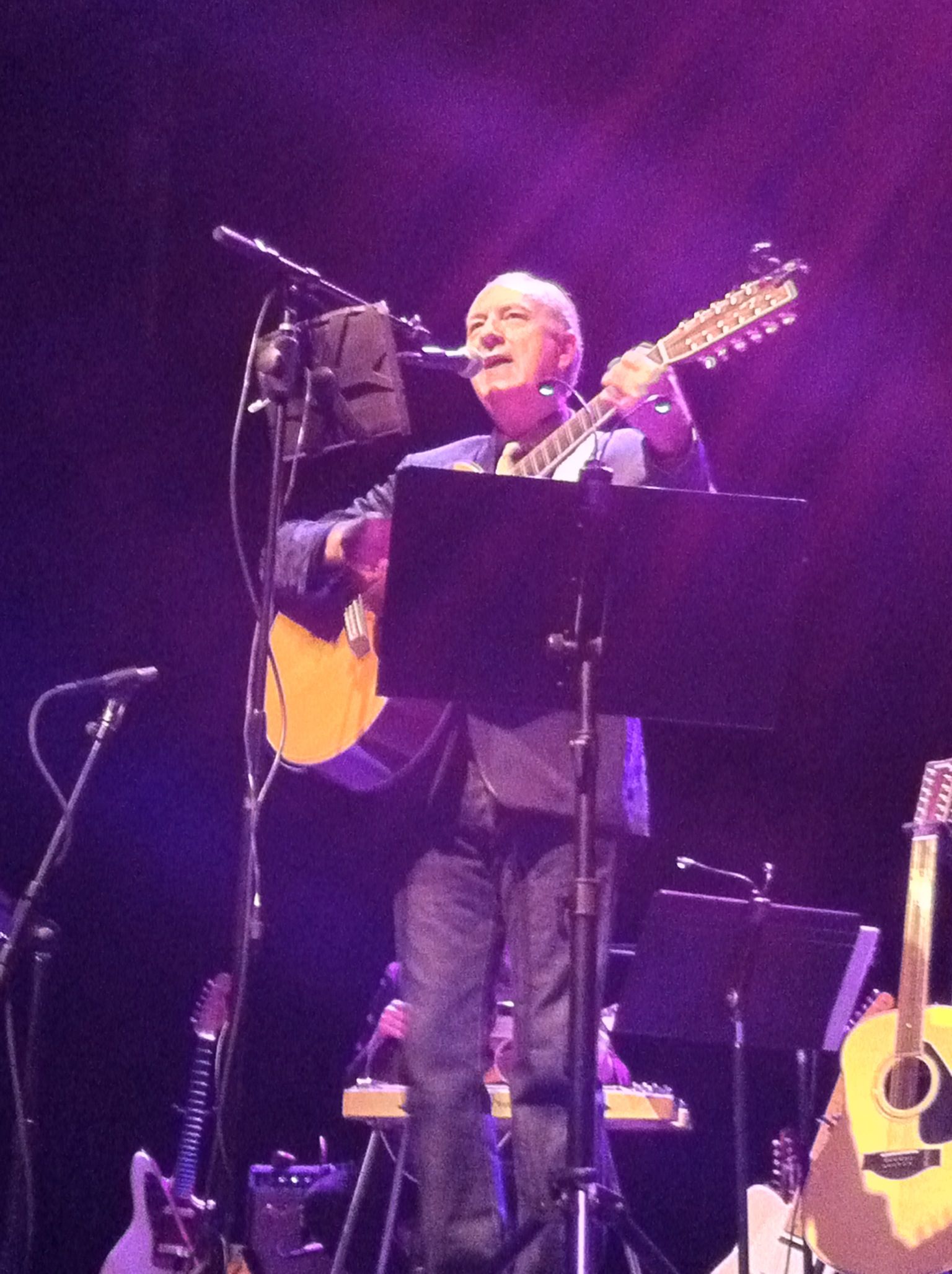
Mike Nesmith, Fitzgerald Theater, St. Paul, MN, 4/5/13

Mike Nesmith, Fitzgerald Theater, St. Paul, MN, 4/5/13

Quick, name a figure from popular culture who has: (a) penned a Top 40 hit that helped launch another artist’s career; (b) starred in a top-rated TV show; (c) pioneered a certain style of popular music; (d) executive-produced a cult movie classic; and (e) created a breakthrough format for presenting music.  Give up?  It’s none other than old Wool Hat himself, Mike Nesmith, who (a) wrote “Different Drum,” the song that made Linda Ronstadt famous; (b) along with Davey Jones, Micky Dolenz and Peter Tork, was a member of the Prefab Four, otherwise known as The Monkees; (c) with his post-Monkees band, The First National Band, is credited with forming the style of music that became known as “country-rock”; (d) was the executive producer of “Repo Man,” and (e) created a music video program called “Pop Clips” for Nickelodeon, which was later sold to Time Warner and became the format for what came to be known as MTV.  Whew!

With that formidable of a résumé, and having just recently turned 70, one would think that Mr. Nesmith would be content to rest on his laurels and enjoy retirement.  Not a chance.  Instead, he has just embarked on his first solo tour in 21 years, landing at A Prairie Home Companion’s home base on Friday, April 5.

Taking the stage without the trademark wool cap of his Monkees’ era (although he probably needed one outdoors on that blustery, cold night), Nesmith looked remarkably trim and fit for a man his age.  Clearly, he was way too smart to get caught up in the rock ‘n roll lifestyle that shortened the life spans of many of his contemporaries.  He even set aside the stool that had been placed onstage for him, preferring instead to stand and strum his 12-string for the entirety of his 90-minute show.

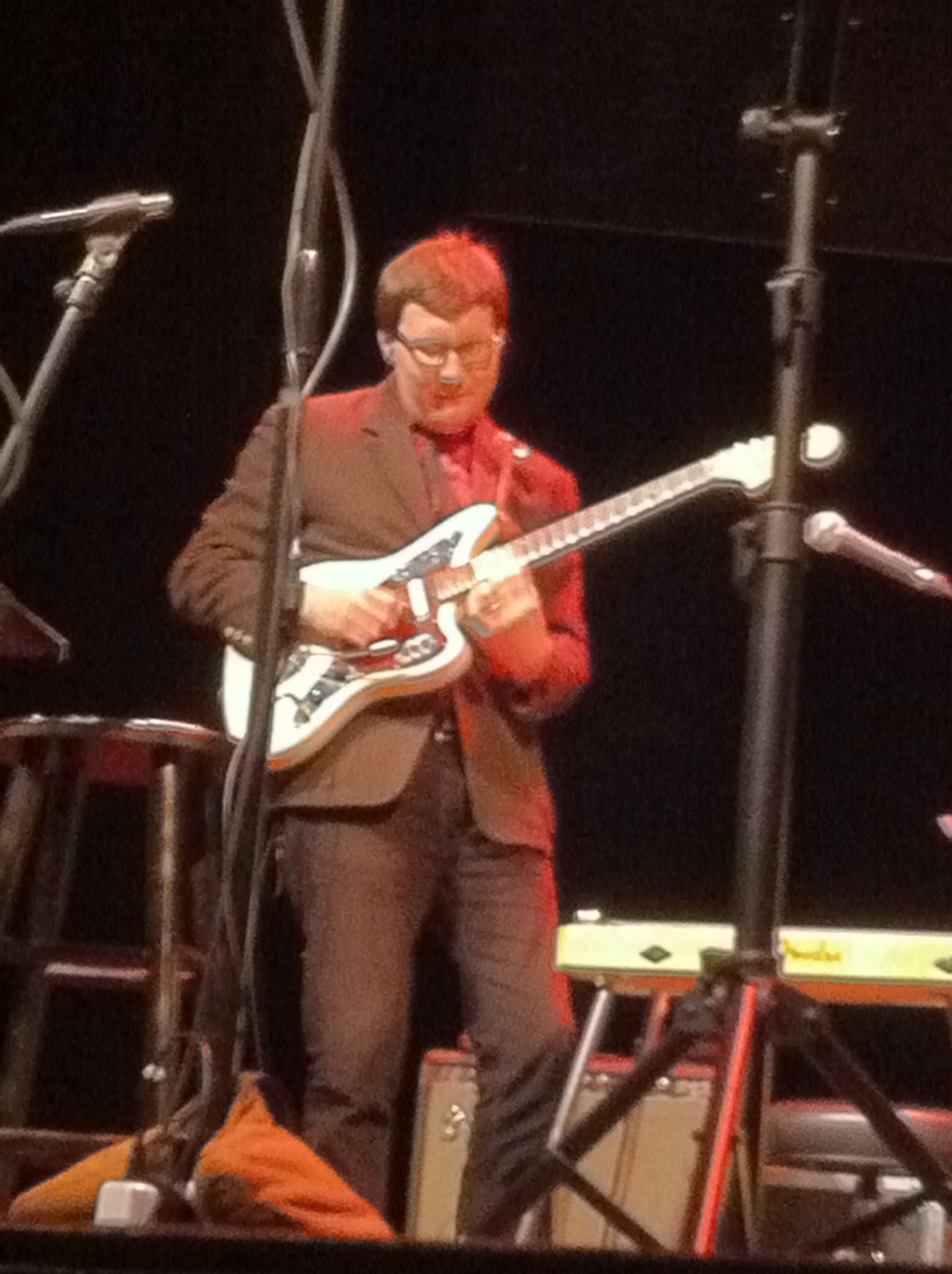
Chris Scruggs
Chris Scruggs

After opening the show with the only song he would play from the Monkees’ catalogue, “Papa Gene’s Blues,” Nesmith took special pains to introduce the members of his band right away.  Although they are all seasoned touring musicians (with individual credits ranging from Pink Floyd to Rascal Flatts), the one name that resonated most loudly with this reviewer was Chris Scruggs, grandson of legendary banjo player Earl Scruggs, and himself a former member of the progressive country band, BR 549.  Young Scruggs did yeoman work on acoustic, electric and steel guitar, and mandolin, all night long.

The format for the evening was somewhat unusual.  Nesmith noted that he would be playing favorites from his solo career, more or less in chronological order, introducing each one by describing a particular setting for the audience to imagine, as the backdrop for the song.  On occasion, the setting would be used for two or three songs played back-to-back, but for the most part each song had its own introduction.  The danger in following such a format is that the momentum created by the previous song will be lost during the exposition of the next selection.  Indeed, by late in the set the process had become somewhat tedious and not terribly enlightening.

From the urban apartment-dweller setting for “Propinquity,” Nesmith led us to the 1930’s, where the ubiquitous He and She encounter each other at a diner, on a moonlit night, but they each drive off alone, in opposite directions, musing about what might have been.  The song, “Tomorrow And Me,” featured a big, orchestral-like arrangement, thanks to the synthesizer work of keyboardist Boh Cooper and Joe Chemay, who did double duty on bass and keys.  1950’s Paris was the backdrop for a couple at crossed paths:  “She wants to be a mother; He wants to be a lover,” intoned Mr. Nesmith.  The song, of course, was “Different Drum,” done in waltz time, with Chris Scruggs on the mandolin and Boh Cooper adding accordion-like touches on his keyboard.

Perhaps his most well-known post-Monkees song, “Joanne,” was coupled with “Silver Moon,” with Scruggs’ pedal steel bolstering Nesmith’s falsetto on the familiar extended verse endings on the former.  Scruggs then employed the unusual technique of using the back of his hand to coax steel drum-like sounds from his steel guitar, for the calypso arrangement on the latter tune.

“Some Of Shelley’s Blues,” was done in slow, deliberate style, a far cry from the Nitty Gritty Dirt Band’s signature country-rock version.  Boh Cooper’s mournful organ intro eventually gave way to a more grandiose solo, with Chris Scruggs once again providing tasteful fills.  Returning to more South of the border rhythms, Nesmith paired the bossa nova of “Rio” with “Casablanca Moonlight,” with drummer Paul Leim doing a nifty job of driving the island beat on the latter on his electronic drum set.

Up to this point, it is unlikely that any of the musicians had broken a sweat.  That would soon change, with a rocking version of “Running From The Grand Ennui,” featuring a monstrous slide solo by Chris Scruggs.  The follow up, the oddball “Cruisin’ (Lucy and Ramona),” with its strange lyrics about three characters meeting on Sunset Strip, was slower, but still forceful, with a bass line that MC Hammer might have borrowed for “Can’t Touch This.”

Nesmith wrapped up the set with a trilogy of songs from his 1974 short story and accompanying EP called “The Prison.”  The “Opening Theme (Life,The Unsuspecting Captive),” was a return to the big, orchestral synthesizer arrangements that marked the early songs of the set, where the pace picked up in the samba-like “Marie’s Theme,” ending, appropriately enough, with the “Closing Theme.” The final song of the set was another Latin-sounding tune, “Laugh Kills Lonesome,” inspired, according to Nesmith, by a Charles Marion Russell painting of a group of cowboys sitting around a campfire, laughing about something.  Perhaps Mel Brooks drew inspiration from the same painting for the notorious campfire scene from “Blazing Saddles.”

The lone encore was further evidence of Nesmith’s tech-savviness.  He recalled his good friend from The First National Band, the late Red Rhodes, whose steel guitar work was the foundation of the band’s seminal country-rock sound.  To pay tribute to his dear friend, Nesmith was able to cull one of Rhodes’ solos from an old concert recording of “Thanx For The Ride,” which he and then band then proceeded to play, with Rhodes’ taped solo meshing perfectly with the live performance.  It was a touching moment, and a generous display of friendship.  And with that, Nesmith and the band linked arms for a farewell bow and left the stage.  One need only look at Nesmith’s website to see where he’s playing next.  However, what direction his amazing and innovative life will take next is anyone’s guess.  Perhaps he himself doesn’t even know.

Chris Scruggs (almost off camera), Mike Nesmith, Boh Cooper, Paul Leim, and Joe Chemay
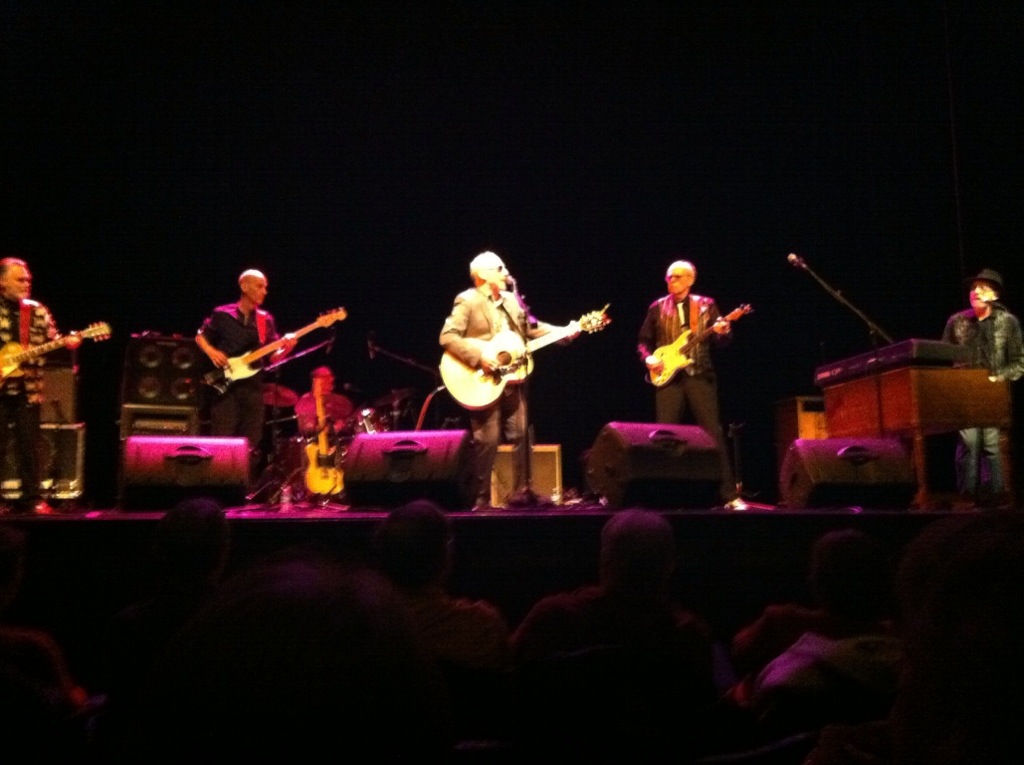
Chris Scruggs (almost off camera), Mike Nesmith, Boh Cooper, Paul Leim, and Joe Chemay

Still Squeezing Out Sparks: Graham Parker and The Rumour, Fitzgerald Theater, St. Paul, MN, 12/19/12

20121220-200517.jpg
Graham Parker and The Rumour stormed ashore in the spring of 1976, the vanguard of a new British Invasion that would later include Elvis Costello, The Sex Pistols, and other punk and new wave bands. But Parker and The Rumour were different. Their sound – a potent mix of soul, r ‘n b and reggae, layered over a solid bar band rock ‘n roll foundation – was a throwback to an earlier era, a fulfillment of Parker’s desire for a band that sounded like “The Rolling Stones backing Bob Dylan.”

Despite widespread critical acclaim, a rabid fan base and a string of outstanding records, Parker and The Rumour parted ways after their 1980 release, “The Up Escalator.” GP decided to pursue a solo career and, although various members of The Rumour would occasionally show up on his records, the full band never got back together until earlier this year. Uber-fan Judd Apatow sought out Parker to appear with his old band in his new movie, “This Is 40,” playing the part of an aging rock group (typecasting, I believe that’s called). Apparently, things clicked when the old pub rockers got together and there’s now a brand new Graham Parker and The Rumour CD out, titled “Three Chords Good,” as well as this recently-completed 15-city tour.

There are advantages and disadvantages to being the final date on a band’s tour. On the one hand, the merch table was pretty well picked over. “Nothing left but some very large T-shirts and a few keychains,” Parker quipped. But, we didn’t come for the swag, we came for the music, and on that score the evening was a stunning success.

Opening with “Fools’ Gold,” the last track on “Heat Treatment,” it was clear that the band had worked out whatever kinks there may have been early on in the tour. Guitarists Brinsley Schwarz (on the gold Les Paul) and Martin Belmont (on the turquoise Strat) mixed in complementary fills (and never once switched out guitars the entire night), while bassist Andrew Bodnar and drummer Stephen Goulding pushed the rhythm, and Bob Andrews added appropriate flourishes on the B-3 and electric piano. Sticking with “Heat Treatment,” the band stepped up the tempo a bit with the randy, rollicking “Hotel Chambermaid.” Graham Parker’s voice was strong, although like many rock singers on the downward side of middle age, he tends to go down register where, on the early records, his voice went up. The camaraderie among the band members was strong and they were clearly in good spirits, exchanging smiles across the stage with each other throughout the evening.

Proving that age has not mellowed his sharp tongue, Parker introduced two songs off the new CD next: the reggae-tinged “Snake Oil Capital Of The World,” and “Coathangers,” a song about . . . freedom of choice, shall we say? Returning to more familiar territory with “I’ll Never Play Jacksonville Again” – an early show highlight – Parker followed that rocker with “Thunder And Rain” from the 1977 release, “Stick To Me.” Before starting that song, however, he told a story about coming to Minneapolis for the first time back in 1976, when the band traveled in a big station wagon “And two of us had to sit looking out the rear window.” He remarked about how cold it was and how they all marveled about how human beings could actually live in that climate. Fortunately for us, he’s never written “I’ll Never Play Minneapolis Again,” and, in fact, he has returned here every summer for the past several years to play a free solo show on or about Bastille Day (that’s July 14, for you non-Francophiles) at a local pub.

Acknowledging that he was in the home theater of A Prairie Home Companion, Parker introduced “Old Soul” from the new album by making a pitch to the audience to petition Garrison Keillor to invite him on the show. “This song would be perfect for the Prairie Home Companion,” he said, half in jest, but entirely truthful, as it turned out. The slower tempo number, with Goulding switching to brushes and Andrews contributing a brief, soulful turn on the B-3, would certainly go over well with the PHC crowd.

After playing the single off the new release, (“Long Emotional Ride”), Parker and the band went back to the roots, launching into the title track to their 1976 debut, “Howlin’ Wind.” Returning to the old song seemed to invigorate Parker and he was more animated during the song than he had been to that point. He twitched and jerked in time to the scratchy reggae riffing of Belmont & Schwarz and the crowd ate it up. Instead of building on that enthusiasm, however, he returned to the new material for the next couple of numbers, “Live In Shadows” and “A Lie Gets You Halfway Round The World.” Good stuff, but we were ready to get back to the classics.

Return they did, starting slowly with “Watch The Moon Come Down,” then picking up the tempo with the trilogy of “Discovering Japan,” “Nobody Hurts You,” and “Protection,” all from 1979’s “Squeezing Out Sparks.” “Stupefaction,” from “The Up Escalator” broke the string, but GP and the Band went right back to the wonderful “SOS” album to close out the set with “Local Girls.”

Encore # 1 started with another new song, “That Moon Was Low,” a country-tinged number that cried out for a pedal steel guitar, with Parker once again plugging it for a spot on A Prairie Home Companion. Returning again to the reliable “Squeezing” release for “Passion Is No Ordinary Word,” it became clear that the crowd would not settle for just these 2 songs.

Encore # 2 was, in many ways, the highlight of a very fine evening. With the crowd already on its feet, Parker & Co. started out with the reggae-fied final track from “Howlin’ Wind,” “Don’t Ask Me Questions,” then pounded out a hard rocking version of “Soul Shoes,” followed by the frenetic “New York Shuffle.” Then, just as Schwarz and Belmont began removing their guitars, with the audience howling, stomping, whistling and clapping, Parker called an audible and the band regrouped and launched into their spectacular version of The Jackson 5’s “I Want You Back.” Where, in prepubescent Michael’s hands, the song is a bouncy, wistful lament about puppy love gone awry, in Parker and The Rumour’s version it becomes the earnest plea of a man who realizes he’s made a terrible mistake and pleads for his lover to return. With Bob Andrews’ glissando slides down the keyboard leading the crescendo to the chorus, The Rumour’s rendition is a much more potent remake than the original. The Fitz was rockin’, the crowd was singing along, and the band was stoking the fire. It was a sensational finale – and it had to be the finale, because anything after that would have been a letdown. Here’s hoping we don’t have to wait another 32 years for the next Graham Parker & The Rumour reunion tour. Until then, remember: only 205 days till Bastille Day!