The Return of the Badgerman: David Lindley at the Cedar Cultural Center, Minneapolis, MN, 5/14/13


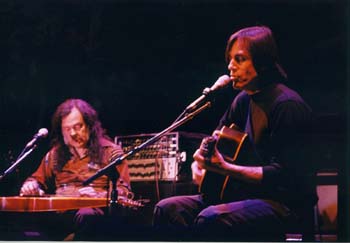
David Lindley and Jackson Brown, circa 1992 (archive photo necessitated by the Cedar's new "no photos" policy during performances

David Lindley and Jackson Browne, circa 1992 (archive photo necessitated by the Cedar’s new “no photos” policy during performances)

If the music industry ever gave out the equivalent of the NBA’s Sixth Man Award, surely David Lindley would be a contender.  In addition to his long affiliation with Jackson Browne, Lindley’s multi-instrumental work has added depth, color and nuance to a veritable who’s who of contemporary artists, including Ry Cooder, Warren Zevon, Rod Stewart, Crosby, Stills and Nash, Emmylou Harris, The Blind Boys of Alabama, Linda Ronstadt, Dolly Parton, John Prine, Bob Dylan, and David Bromberg.  And that’s just for starters!  His long affiliation with the group of session musicians known as The Section has led him to appear on scores of albums.  For approximately 10 years, he led the much-loved, sorely-missed, multi-cultural cult favorite band, El Rayo -X, with its captivating mix of rock, blues and reggae.  As one of the earliest champions of “world music,” he toured and recorded with Jordanian musician Hani Naser, as well as venturing to Madagascar with guitarist Henry Kaiser, to record with musicians there
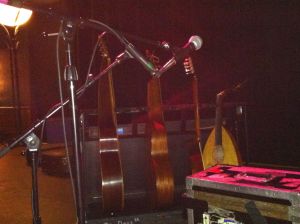
The Axe-Man cometh!  David Lindley's instruments, including a massive baritone Hawaiian guitar, normal Hawaiian guitar, bouzouki and oud.
The Axe-Man cometh! David Lindley’s instruments, including a massive baritone Hawaiian guitar, normal Hawaiian guitar, bouzouki and oud.

Although he is still regularly called upon for session work, Lindley’s preference these days is to tour solo, dazzling audiences with his deft fretwork on a variety of instruments, including bouzouki, oud, and an impressive set of Hawaiian style hollow neck acoustic lap guitars.  So it was during his recent appearance at the Cedar Cultural Center, where he entertained the 2/3’s full house for nearly two hours, with his mix of songs and story telling.

Bespectacled, with his long graying hair and signature massive mutton chops, Lindley resembled a character out of a Dickens novel – except for the loud paisley-print shirt, that is (standard apparel for the man occasionally referred to as The Prince of Polyester).  “Ain’t No Way” from the first El Rayo-X album, was the set opener, done up more as a stately march than the loose, freewheeling arrangement from the 1981 album.  Reflecting on his early career, Lindley noted that he used to play at Disneyland in a hillbilly band “with our bumpkin suits, bumpkin hats, and bumpkin instruments.”  One of the members of the group was a much older man named Johnny Sancere, who played banjo and guitar, and whose longevity in the business while playing the style of music he preferred seems to have had a profound influence on Lindley’s own chosen career path.  He used the Disneyland/Sancere episode as a segue into “Coot From Tennessee,” then the Warren Zevon composition “Beneath The Vast Indifference of Heaven,” both played on Hawaiian-style acoustic lap guitars.  The hollow necks of these formidable instruments provided a huge, resonating bottom to the songs, making it sound for all the world as though there was a bass player up on stage, too.

Referring to the recent Rolling Stone article about The Section, Lindley related a story about saxophonist David Sanborn (“the Troll of Soul,” as Lindley referred to him),, making his way from ledge to ledge along the second story outside wall of the Holiday Inn where the band was staying while touring with Jackson Browne.  Finally persuaded to come into the room from his precarious perch, Sanborn pointed at someone in the band and proclaimed “You and your little dog, too!” causing Lindley to howl with laughter at the recollection, while the audience politely chuckled in puzzled amusement.  I guess you had to have been there.

Announcing, “I’d like to do a drug song for you,” Lindley told of how he and his daughter, Rosanne, came to write “Little Green Bottle,” an ode to . . . Extra Strength Excedrin.  It occurred after Lindley had been bitten between the shoulder blades by some nasty tree spider that dropped down on him as he brushed against a branch.  Only the magic in the little green bottle soothed his pain, so, while walking with Rosanne soon after – in the street, away from spider-infested trees – they began tossing off verses, eventually winding up with “about 30.”  Although the version performed this night consisted of far fewer verses, the song itself went on for over 10 minutes, including hilarious spoken interludes about taking too much (leading to “bad musical ideas” and manic guitar playing), then coming down from the Excedrin high (slowing the song down to a dirge).

Back to the bouzouki, and another story about doing sessions with Dolly Parton, including an extravagant show at her Dollywood theme park, with a number of other guest musicians.  Dolly introduced the musicians one by one, noting that so-and-so came in from New York, so-and-so from Los Angeles, and when she got to Lindley, she announced “And David Lindley flew in from Mars!”  The murder ballad, “Pretty Polly” was the follow up to that anecdote.

Switching to the oud, Lindley pointed out that the one he plays does not have the rounded back traditional for this Middle Eastern instrument.  “That’s because this oud was made to be plugged into a Marshall stack!” he noted, referring to his oud as “Destroys Drummers.”  The bluegrass tune, “Little Sadie” was the first offering on this tricky instrument, followed by a medley of similar songs.  The similarity between oud and mandolin in terms of size and number of strings (although the oud has 2 more) makes the oud a simpatico choice for bluegrass style music.

Back to bouzouki next for the Greg Copeland tune, “Pretty Girl Rules The World,” followed by another Greg Copeland composition, “Revenge Will Come,” played on the thunderous baritone Hawaiian.  In between, Lindley told a story about the man who makes his lap guitars, a fellow by the name of Larry Pogreba, a neighbor of Ted Turner’s, who lives “off the grid” in Montana, and also builds black powder cannons that shoot bowling balls!  It was just such a cannon that dispatched the ashes of Pogreba’s friend, the late Hunter S. Thompson, over his property in Colorado.  Whatever else you might say about David Lindley, you certainly can’t accuse him of having boring friends.

Before performing his lone encore, the zydeco flavored “Bon Temps Roulez,” Lindley referred back to the Rolling Stone article on The Section.  He took umbrage at the writer’s reference to the group as “The Knights of Soft Rock,” so he decided to give himself yet another nickname:  Flaccido Domingo.  That line got him the biggest laugh of the night.

It’s easy to see how David Lindley is such an in-demand studio musician.  His range of instrumental skills is unique, but in addition to that his easygoing demeanor and “what, me worry?” attitude toward life must be refreshing in a business where over-inflated egos are the norm.  Fortunately for us, he still spends a lot of time on the road, playing in bars and clubs, and at festivals all over the world.  Alone on stage, flanked by his rack of instruments, is where his true genius shines forth – with a half-dozen humorous anecdotes thrown in for good measure.
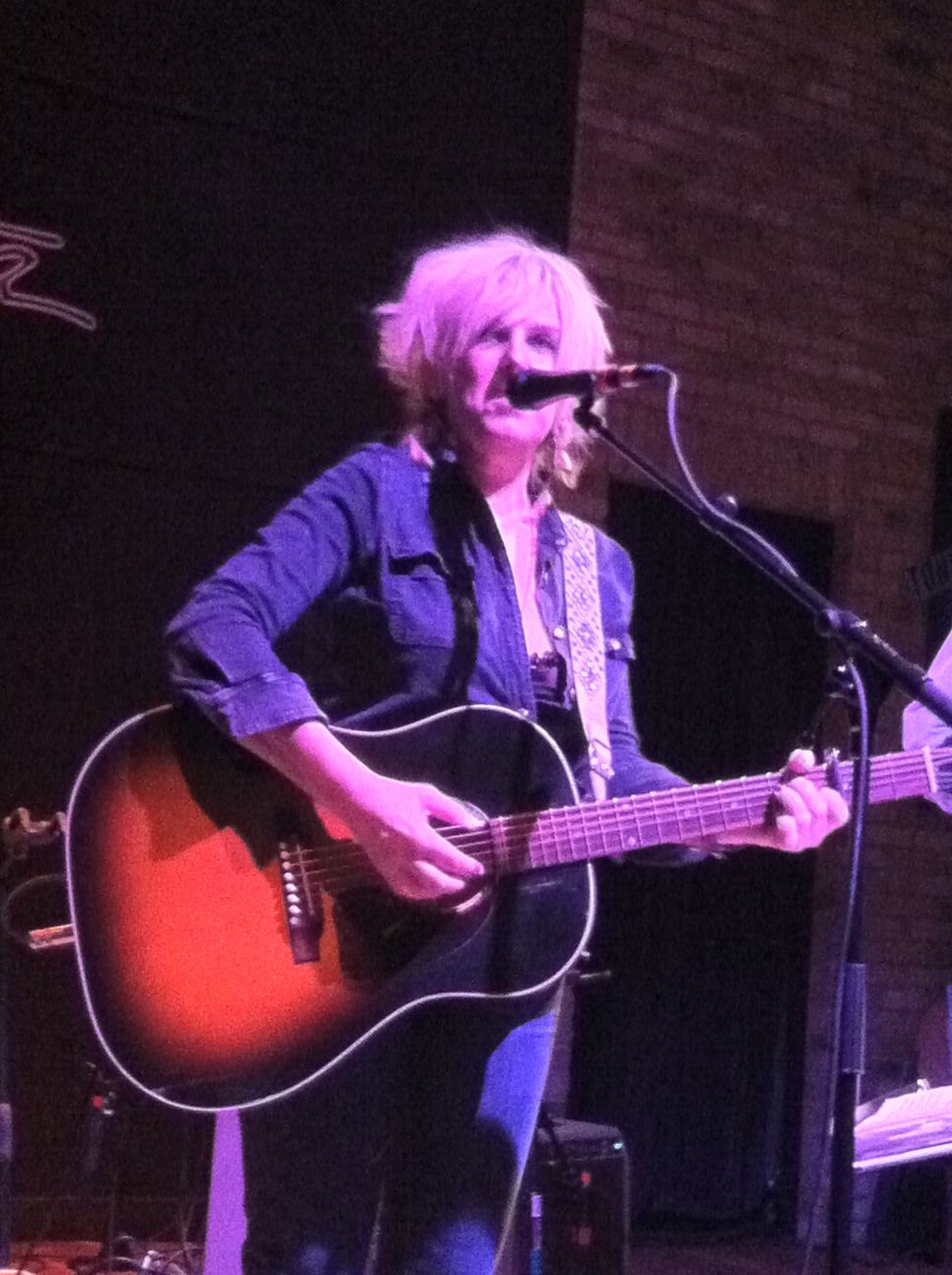
Americana Queen Reigns Supreme: Lucinda Williams at The Dakota Jazz Club, Minneapolis, MN, 2/6/13

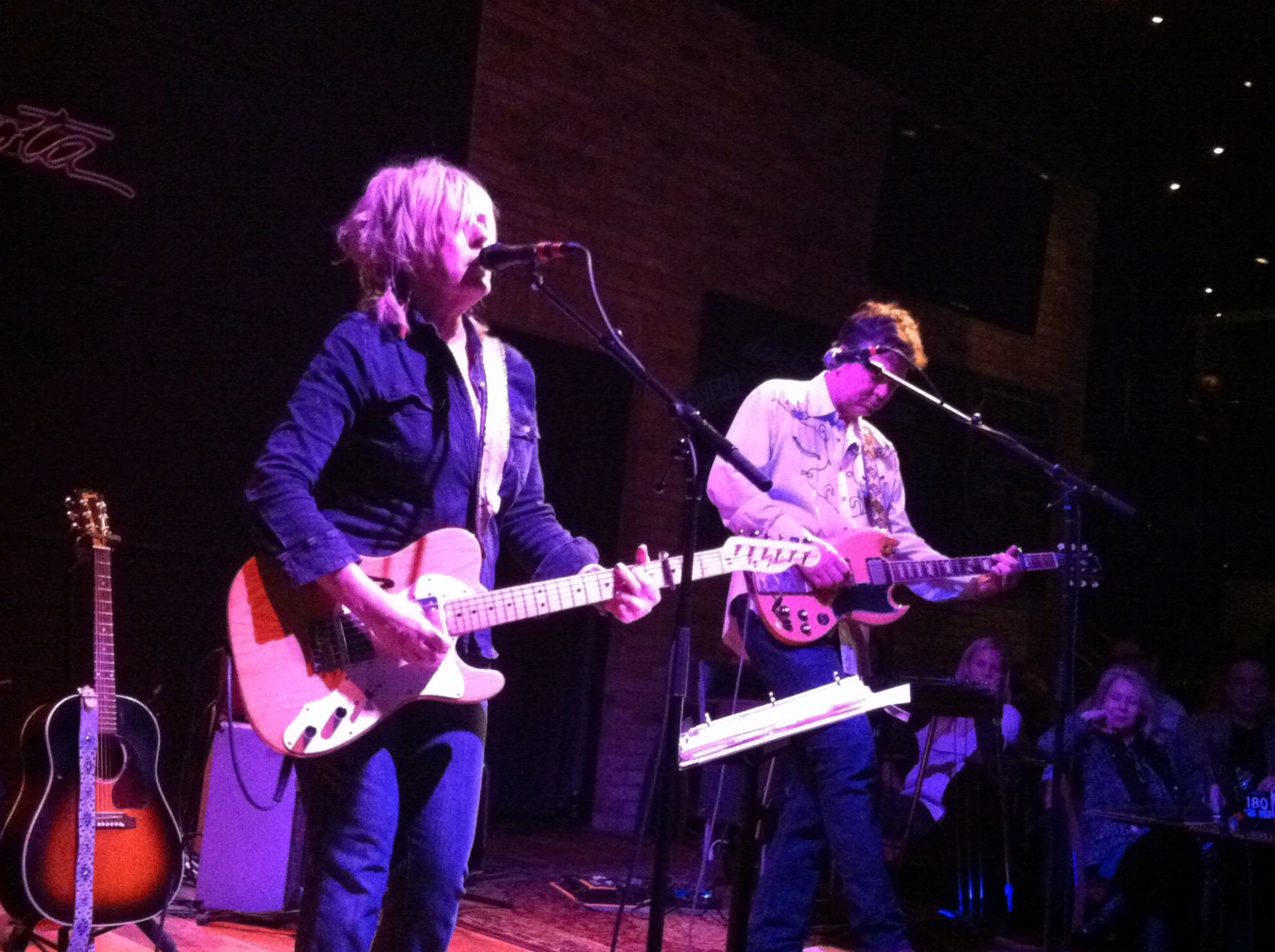
Lucinda Williams, with Doug Pettibone

Lucinda Williams, with Doug Pettibone

Minneapolis has become something of a second home for Lucinda Williams. Her 2003 release “World Without Tears” included a song called “Minneapolis,” and also “Real Live Bleeding Fingers And Broken Guitar Strings,” purportedly written about Paul Westerberg of The Replacements. In 2009, she married Minnesota-born Tom Overby onstage at First Avenue, in a post-concert service that was surprisingly moving, given the unholy setting. With her apparent affinity for the Twin Cities, it was no surprise that by the fourth night of her five-night “residency” at the Dakota, she seemed completely at ease; comfortable in her surroundings, friendly and gracious with the crowd, and calm and self-assured in her delivery. None of this detracted from the passion and conviction of her performance – the best of the half-dozen times this writer has seen her.

Following brief opening sets by Ben Kyle (Romantica) and The Kenneth Brian Band, Lucinda and her longtime guitarist, the incomparable Doug Pettibone, took the stage and opened with “Can’t Let Go,” a song written by St. Paulite Randy Weeks – yet another local connection! – from her 1998 masterpiece, “Car Wheels On A Gravel Road.” Doug Pettibone was already making his presence felt, with sharp, focused lead and bottleneck slide work on this uptempo breakup song. Reaching back nearly 25 years to her eponymous 1988 release, for the next number, “Big Red Sun Blues,” it was clear that Lucinda was going to make the most of her deep catalogue by sprinkling her set list with obscure gems, as well as more familiar favorites.

The title track to “Car Wheels” certainly fell into the latter category. Introducing it, she told a deeply personal story of having debuted the song at the intimate Bluebird Café in Nashville, before an audience that included her father, the writer and poet, Miller Williams. Afterward, he commented that she must have been the little girl in the verse: “Chld in the back seat, about four or five years / Lookin’ out the window”. In complete and convincing sincerity, Lucinda said that she had never realized that until her father pointed it out to her, so complete was her immersion in her writing.

Slowing down the pace, Lucinda next chose the title track to “World Without Tears,” an achingly beautiful ballad that showcased her world-weary voice to its best advantage. Doug Pettibone switched from his Strat to a big hollow body Gretsch for the tender solos on this one, adding understated harmony to Lucinda’s vocals, as he did all night. Keeping the mood somber, Ms. Williams told of having been inspired to write “Memphis Pearl” in 1984, by the sight of a poor woman digging through trash cans, looking for food. The gentle, bluegrass-flavored song tells the story of a fallen angel, a girl whose high hopes and big dreams are sadly unrealized. It is a common theme of Ms. Williams, who relates tales of the downtrodden and those living on the fringes of society, without ever becoming maudlin, condescending or judgmental.

"Back in Memphis she was a pearl"

“Back in Memphis she was a pearl”

Lucinda kept the mood subdued and intimate with “Tears Of Joy,” a love song to Tom Overby, from her 2008 release, “Little Honey.” Introducing the next song, “I Don’t Know How You’re Living,” Lucinda noted that it was written for her younger brother, “who I haven’t seen in many years.” Incredibly sad and moving, featuring sublime echo-effect guitar work by Doug Pettibone, the pairing of the song with “Tears Of Joy” was breathtaking. Where “Tears Of Joy” celebrates the emotional catharsis of falling deeply in love, “Don’t Know” reminds us of the pain and longing that comes from being estranged from someone we were once close to. “I don’t know how you’re living / I don’t know where you are / And you may not be willing / To open up the door.” The yin and yang of interpersonal relations, encapsulated in two songs. Stunning.

To bring us out of our doldrums, at least momentarily, Lucinda debuted a new song, “Stowaway,” a mid-tempo rocker that’s sure to appear on her next album. “Born To Be Loved,” from her most recent album, “Blessed,” was next, followed by “Everything Is Changed,” from 2007’s “West,” featuring Miss Lily Mae Rische from The Kenneth Brian Band on fiddle. Lily Mae and her fiddle stuck around for “Jailhouse Tears,” giving the song a more country, less rocking feel than the studio version (that paired Lucinda with guest vocalist Elvis Costello). The ease with which Lucinda traded verses with Doug Pettibone erased all the bad memories of her tortured attempt at the song during her 2008 First Avenue appearance – simulcast on the internet – when she stopped and started the song four times before finally being able to finish it.

Returning to the land of broken dreams and tragic characters, Lucinda noted that “you meet a lot of beautiful losers in this business,” and told the story of Blaze Foley, a gifted songwriter whose songs have been recorded by Merle Haggard, Willie Nelson, and John Prine, among others. But, possessed by his own demons, he barely eked out a living on the fringes of society before being shot and killed in a senseless confrontation. “Drunken Angel” from the “Car Wheels” album is Lucinda’s tribute to this singular talent, whose life and death are straight out of a Greek tragedy.

The tempo picked up and the set list continued its wide range thereafter, as Lucinda debuted another new song, a driving, soulful number that might be titled “I Need Protection (From The Enemy of Love),” followed by the title track to 2001’s “Essence,” with Doug Pettibone producing stinging notes on his Gibson SG. To amp up the proceedings, Lucinda switched from her big Gibson acoustic to a Telecaster for the remainder of the night, starting with a Delta blues number by Little Son Jackson, “Disgusted,” followed by a ferocious version of “Change The Locks,” then a new version of “Joy” (recorded as part of a compilation to support the West Memphis Three), and a hard-rocking ‘Honey Bee” to close out the set.

Before starting the encore, Lucinda complimented the crowd, saying “y’all might be the liveliest audience yet!” She then opened the three-song encore with “Blessed,” an inspired piece of songwriting that takes the biblical Beatitudes and turns them around 180 degrees. Instead of the meek, the humble, the poor in spirit being blessed by the diety, it is we who are blessed by them: “We were blessed by the girl selling roses / Showed us how to live / We were blessed by the neglected child / Who knew how to forgive.” It is a brilliant, thought-provoking piece of songwriting. Not wanting to leave us with anything too heavy, Lucinda brought Lily Mae and the rest of the Kenneth Brian Band back on stage for the rollicking Hank Williams party tune, “Jambalaya,” and a hand-clapping, foot-stomping gospel cover, “You Know You’ve Got To Get Right With God.”

The little girl in the back seat of the car is all grown up now, and she’s moved behind the steering wheel. The tank is full, the engine is well-tuned, and those tires still have a lot of life left in them. The road ahead is wide open and there’s still a lot of this sweet old world left for Lucinda to discover. We’ll all be waiting for her when she swings by next time, to tell us all about it.