
The Return of the Badgerman: David Lindley at the Cedar Cultural Center, Minneapolis, MN, 5/14/13


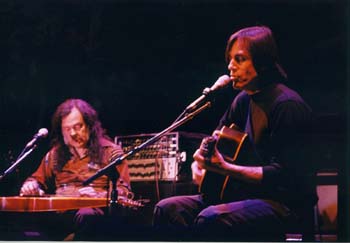
David Lindley and Jackson Brown, circa 1992 (archive photo necessitated by the Cedar's new "no photos" policy during performances

David Lindley and Jackson Browne, circa 1992 (archive photo necessitated by the Cedar’s new “no photos” policy during performances)

If the music industry ever gave out the equivalent of the NBA’s Sixth Man Award, surely David Lindley would be a contender.  In addition to his long affiliation with Jackson Browne, Lindley’s multi-instrumental work has added depth, color and nuance to a veritable who’s who of contemporary artists, including Ry Cooder, Warren Zevon, Rod Stewart, Crosby, Stills and Nash, Emmylou Harris, The Blind Boys of Alabama, Linda Ronstadt, Dolly Parton, John Prine, Bob Dylan, and David Bromberg.  And that’s just for starters!  His long affiliation with the group of session musicians known as The Section has led him to appear on scores of albums.  For approximately 10 years, he led the much-loved, sorely-missed, multi-cultural cult favorite band, El Rayo -X, with its captivating mix of rock, blues and reggae.  As one of the earliest champions of “world music,” he toured and recorded with Jordanian musician Hani Naser, as well as venturing to Madagascar with guitarist Henry Kaiser, to record with musicians there
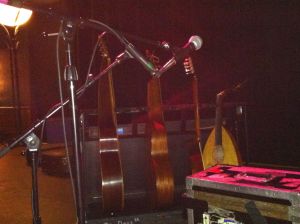
The Axe-Man cometh!  David Lindley's instruments, including a massive baritone Hawaiian guitar, normal Hawaiian guitar, bouzouki and oud.
The Axe-Man cometh! David Lindley’s instruments, including a massive baritone Hawaiian guitar, normal Hawaiian guitar, bouzouki and oud.

Although he is still regularly called upon for session work, Lindley’s preference these days is to tour solo, dazzling audiences with his deft fretwork on a variety of instruments, including bouzouki, oud, and an impressive set of Hawaiian style hollow neck acoustic lap guitars.  So it was during his recent appearance at the Cedar Cultural Center, where he entertained the 2/3’s full house for nearly two hours, with his mix of songs and story telling.

Bespectacled, with his long graying hair and signature massive mutton chops, Lindley resembled a character out of a Dickens novel – except for the loud paisley-print shirt, that is (standard apparel for the man occasionally referred to as The Prince of Polyester).  “Ain’t No Way” from the first El Rayo-X album, was the set opener, done up more as a stately march than the loose, freewheeling arrangement from the 1981 album.  Reflecting on his early career, Lindley noted that he used to play at Disneyland in a hillbilly band “with our bumpkin suits, bumpkin hats, and bumpkin instruments.”  One of the members of the group was a much older man named Johnny Sancere, who played banjo and guitar, and whose longevity in the business while playing the style of music he preferred seems to have had a profound influence on Lindley’s own chosen career path.  He used the Disneyland/Sancere episode as a segue into “Coot From Tennessee,” then the Warren Zevon composition “Beneath The Vast Indifference of Heaven,” both played on Hawaiian-style acoustic lap guitars.  The hollow necks of these formidable instruments provided a huge, resonating bottom to the songs, making it sound for all the world as though there was a bass player up on stage, too.

Referring to the recent Rolling Stone article about The Section, Lindley related a story about saxophonist David Sanborn (“the Troll of Soul,” as Lindley referred to him),, making his way from ledge to ledge along the second story outside wall of the Holiday Inn where the band was staying while touring with Jackson Browne.  Finally persuaded to come into the room from his precarious perch, Sanborn pointed at someone in the band and proclaimed “You and your little dog, too!” causing Lindley to howl with laughter at the recollection, while the audience politely chuckled in puzzled amusement.  I guess you had to have been there.

Announcing, “I’d like to do a drug song for you,” Lindley told of how he and his daughter, Rosanne, came to write “Little Green Bottle,” an ode to . . . Extra Strength Excedrin.  It occurred after Lindley had been bitten between the shoulder blades by some nasty tree spider that dropped down on him as he brushed against a branch.  Only the magic in the little green bottle soothed his pain, so, while walking with Rosanne soon after – in the street, away from spider-infested trees – they began tossing off verses, eventually winding up with “about 30.”  Although the version performed this night consisted of far fewer verses, the song itself went on for over 10 minutes, including hilarious spoken interludes about taking too much (leading to “bad musical ideas” and manic guitar playing), then coming down from the Excedrin high (slowing the song down to a dirge).

Back to the bouzouki, and another story about doing sessions with Dolly Parton, including an extravagant show at her Dollywood theme park, with a number of other guest musicians.  Dolly introduced the musicians one by one, noting that so-and-so came in from New York, so-and-so from Los Angeles, and when she got to Lindley, she announced “And David Lindley flew in from Mars!”  The murder ballad, “Pretty Polly” was the follow up to that anecdote.

Switching to the oud, Lindley pointed out that the one he plays does not have the rounded back traditional for this Middle Eastern instrument.  “That’s because this oud was made to be plugged into a Marshall stack!” he noted, referring to his oud as “Destroys Drummers.”  The bluegrass tune, “Little Sadie” was the first offering on this tricky instrument, followed by a medley of similar songs.  The similarity between oud and mandolin in terms of size and number of strings (although the oud has 2 more) makes the oud a simpatico choice for bluegrass style music.

Back to bouzouki next for the Greg Copeland tune, “Pretty Girl Rules The World,” followed by another Greg Copeland composition, “Revenge Will Come,” played on the thunderous baritone Hawaiian.  In between, Lindley told a story about the man who makes his lap guitars, a fellow by the name of Larry Pogreba, a neighbor of Ted Turner’s, who lives “off the grid” in Montana, and also builds black powder cannons that shoot bowling balls!  It was just such a cannon that dispatched the ashes of Pogreba’s friend, the late Hunter S. Thompson, over his property in Colorado.  Whatever else you might say about David Lindley, you certainly can’t accuse him of having boring friends.

Before performing his lone encore, the zydeco flavored “Bon Temps Roulez,” Lindley referred back to the Rolling Stone article on The Section.  He took umbrage at the writer’s reference to the group as “The Knights of Soft Rock,” so he decided to give himself yet another nickname:  Flaccido Domingo.  That line got him the biggest laugh of the night.

It’s easy to see how David Lindley is such an in-demand studio musician.  His range of instrumental skills is unique, but in addition to that his easygoing demeanor and “what, me worry?” attitude toward life must be refreshing in a business where over-inflated egos are the norm.  Fortunately for us, he still spends a lot of time on the road, playing in bars and clubs, and at festivals all over the world.  Alone on stage, flanked by his rack of instruments, is where his true genius shines forth – with a half-dozen humorous anecdotes thrown in for good measure.

No Monkee-ing Around: Michael Nesmith at the Fitzgerald Theater, St. Paul, MN, 4/5/13

Mike Nesmith, Fitzgerald Theater, St. Paul, MN, 4/5/13

Mike Nesmith, Fitzgerald Theater, St. Paul, MN, 4/5/13

Quick, name a figure from popular culture who has: (a) penned a Top 40 hit that helped launch another artist’s career; (b) starred in a top-rated TV show; (c) pioneered a certain style of popular music; (d) executive-produced a cult movie classic; and (e) created a breakthrough format for presenting music.  Give up?  It’s none other than old Wool Hat himself, Mike Nesmith, who (a) wrote “Different Drum,” the song that made Linda Ronstadt famous; (b) along with Davey Jones, Micky Dolenz and Peter Tork, was a member of the Prefab Four, otherwise known as The Monkees; (c) with his post-Monkees band, The First National Band, is credited with forming the style of music that became known as “country-rock”; (d) was the executive producer of “Repo Man,” and (e) created a music video program called “Pop Clips” for Nickelodeon, which was later sold to Time Warner and became the format for what came to be known as MTV.  Whew!

With that formidable of a résumé, and having just recently turned 70, one would think that Mr. Nesmith would be content to rest on his laurels and enjoy retirement.  Not a chance.  Instead, he has just embarked on his first solo tour in 21 years, landing at A Prairie Home Companion’s home base on Friday, April 5.

Taking the stage without the trademark wool cap of his Monkees’ era (although he probably needed one outdoors on that blustery, cold night), Nesmith looked remarkably trim and fit for a man his age.  Clearly, he was way too smart to get caught up in the rock ‘n roll lifestyle that shortened the life spans of many of his contemporaries.  He even set aside the stool that had been placed onstage for him, preferring instead to stand and strum his 12-string for the entirety of his 90-minute show.

Chris Scruggs
Chris Scruggs

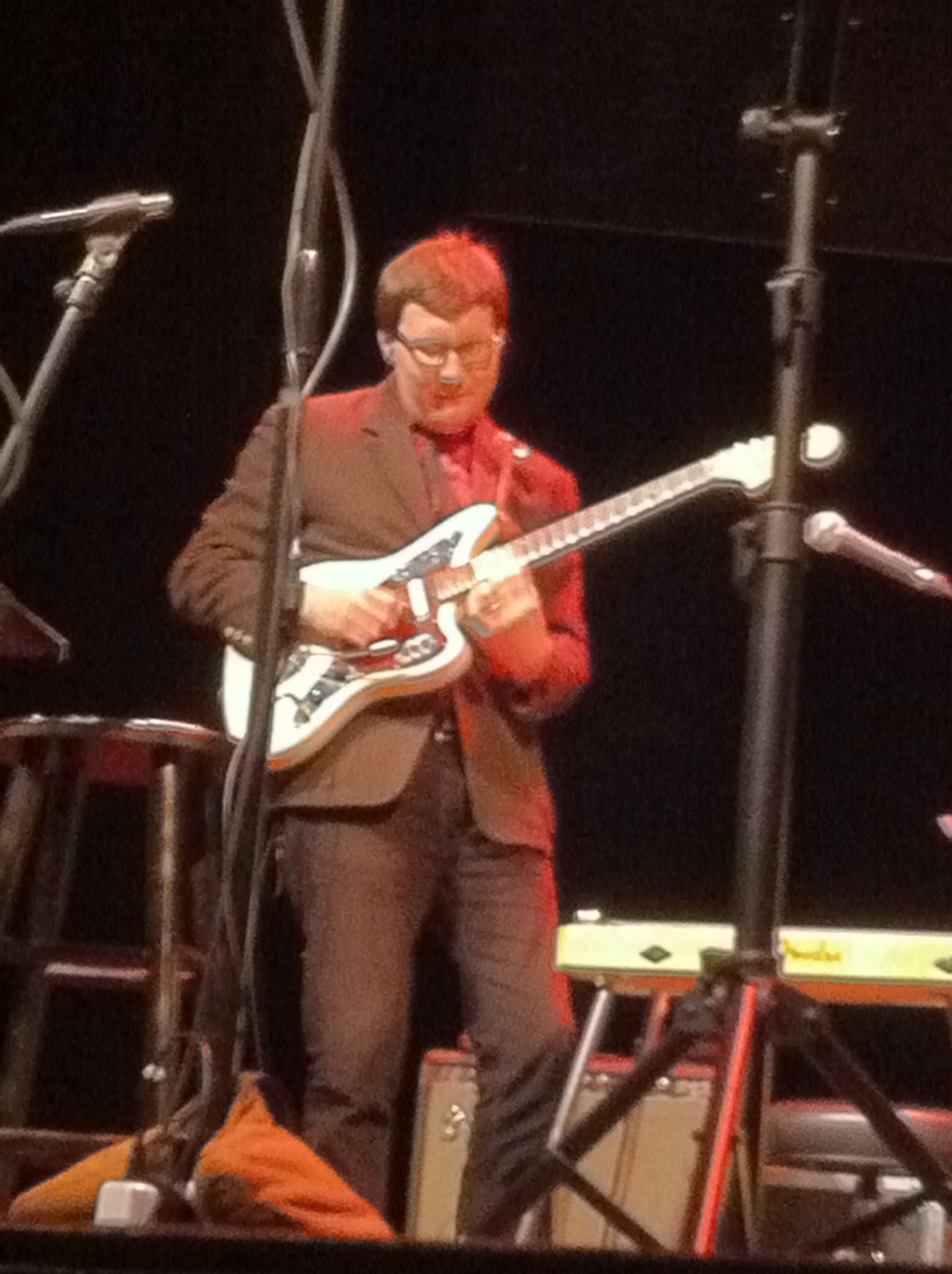
After opening the show with the only song he would play from the Monkees’ catalogue, “Papa Gene’s Blues,” Nesmith took special pains to introduce the members of his band right away.  Although they are all seasoned touring musicians (with individual credits ranging from Pink Floyd to Rascal Flatts), the one name that resonated most loudly with this reviewer was Chris Scruggs, grandson of legendary banjo player Earl Scruggs, and himself a former member of the progressive country band, BR 549.  Young Scruggs did yeoman work on acoustic, electric and steel guitar, and mandolin, all night long.

The format for the evening was somewhat unusual.  Nesmith noted that he would be playing favorites from his solo career, more or less in chronological order, introducing each one by describing a particular setting for the audience to imagine, as the backdrop for the song.  On occasion, the setting would be used for two or three songs played back-to-back, but for the most part each song had its own introduction.  The danger in following such a format is that the momentum created by the previous song will be lost during the exposition of the next selection.  Indeed, by late in the set the process had become somewhat tedious and not terribly enlightening.

From the urban apartment-dweller setting for “Propinquity,” Nesmith led us to the 1930’s, where the ubiquitous He and She encounter each other at a diner, on a moonlit night, but they each drive off alone, in opposite directions, musing about what might have been.  The song, “Tomorrow And Me,” featured a big, orchestral-like arrangement, thanks to the synthesizer work of keyboardist Boh Cooper and Joe Chemay, who did double duty on bass and keys.  1950’s Paris was the backdrop for a couple at crossed paths:  “She wants to be a mother; He wants to be a lover,” intoned Mr. Nesmith.  The song, of course, was “Different Drum,” done in waltz time, with Chris Scruggs on the mandolin and Boh Cooper adding accordion-like touches on his keyboard.

Perhaps his most well-known post-Monkees song, “Joanne,” was coupled with “Silver Moon,” with Scruggs’ pedal steel bolstering Nesmith’s falsetto on the familiar extended verse endings on the former.  Scruggs then employed the unusual technique of using the back of his hand to coax steel drum-like sounds from his steel guitar, for the calypso arrangement on the latter tune.

“Some Of Shelley’s Blues,” was done in slow, deliberate style, a far cry from the Nitty Gritty Dirt Band’s signature country-rock version.  Boh Cooper’s mournful organ intro eventually gave way to a more grandiose solo, with Chris Scruggs once again providing tasteful fills.  Returning to more South of the border rhythms, Nesmith paired the bossa nova of “Rio” with “Casablanca Moonlight,” with drummer Paul Leim doing a nifty job of driving the island beat on the latter on his electronic drum set.

Up to this point, it is unlikely that any of the musicians had broken a sweat.  That would soon change, with a rocking version of “Running From The Grand Ennui,” featuring a monstrous slide solo by Chris Scruggs.  The follow up, the oddball “Cruisin’ (Lucy and Ramona),” with its strange lyrics about three characters meeting on Sunset Strip, was slower, but still forceful, with a bass line that MC Hammer might have borrowed for “Can’t Touch This.”

Nesmith wrapped up the set with a trilogy of songs from his 1974 short story and accompanying EP called “The Prison.”  The “Opening Theme (Life,The Unsuspecting Captive),” was a return to the big, orchestral synthesizer arrangements that marked the early songs of the set, where the pace picked up in the samba-like “Marie’s Theme,” ending, appropriately enough, with the “Closing Theme.” The final song of the set was another Latin-sounding tune, “Laugh Kills Lonesome,” inspired, according to Nesmith, by a Charles Marion Russell painting of a group of cowboys sitting around a campfire, laughing about something.  Perhaps Mel Brooks drew inspiration from the same painting for the notorious campfire scene from “Blazing Saddles.”

The lone encore was further evidence of Nesmith’s tech-savviness.  He recalled his good friend from The First National Band, the late Red Rhodes, whose steel guitar work was the foundation of the band’s seminal country-rock sound.  To pay tribute to his dear friend, Nesmith was able to cull one of Rhodes’ solos from an old concert recording of “Thanx For The Ride,” which he and then band then proceeded to play, with Rhodes’ taped solo meshing perfectly with the live performance.  It was a touching moment, and a generous display of friendship.  And with that, Nesmith and the band linked arms for a farewell bow and left the stage.  One need only look at Nesmith’s website to see where he’s playing next.  However, what direction his amazing and innovative life will take next is anyone’s guess.  Perhaps he himself doesn’t even know.

Chris Scruggs (almost off camera), Mike Nesmith, Boh Cooper, Paul Leim, and Joe Chemay

Chris Scruggs (almost off camera), Mike Nesmith, Boh Cooper, Paul Leim, and Joe Chemay