
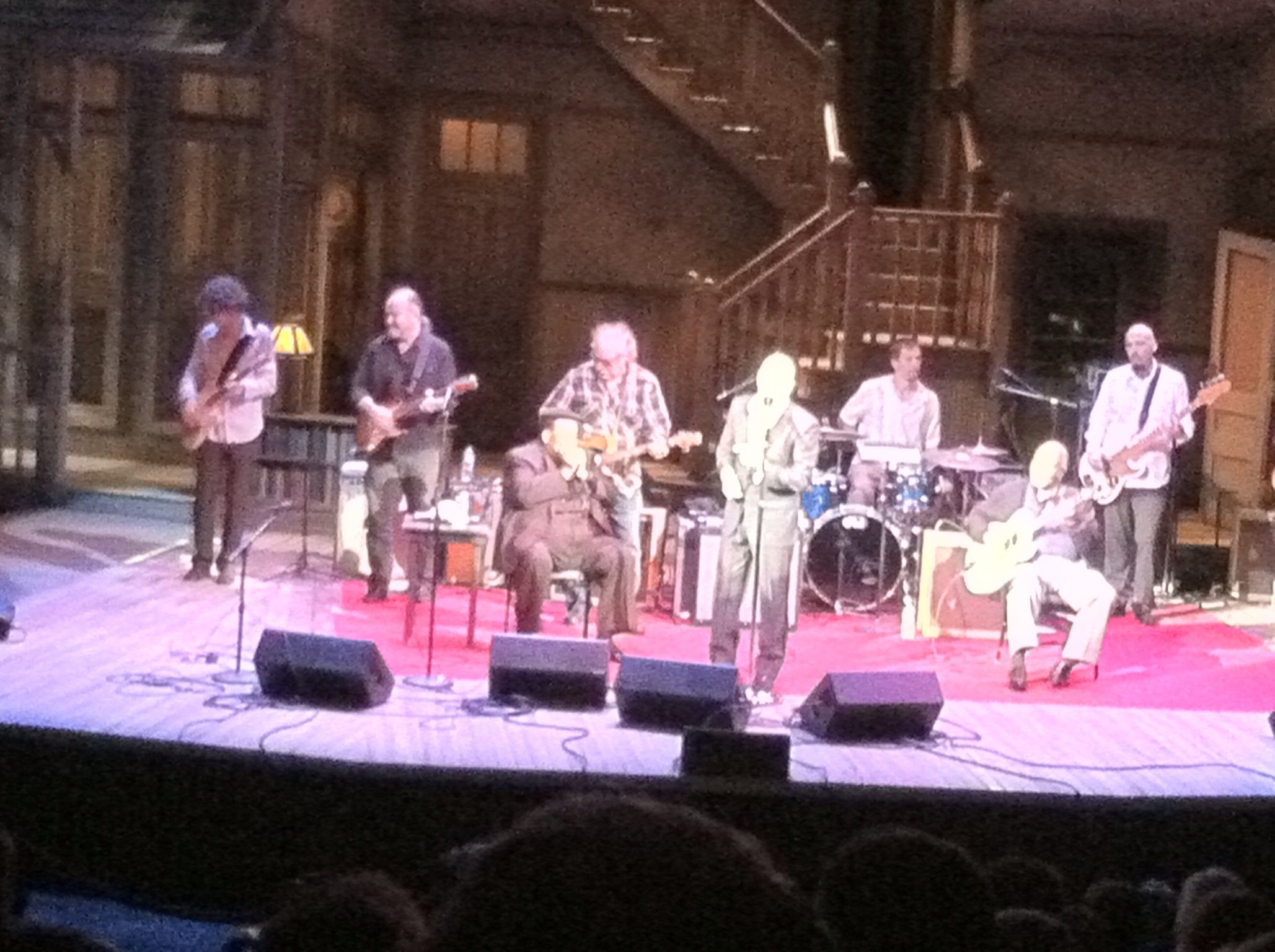
“Got their mojos workin’!”; Seated: James Cotton (L), Jody Williams (R); Standing: Tinsley Ellis (2nd L), Bob Margolin (3rd L); Kim Wilson (Center) with the rest of The Fabulous Thunderbirds arrayed behind him
BLUES AT THE CROSSROADS 2: MUDDY & THE WOLF, GUTHRIE THEATER, MINNEAPOLIS, MN, 2/4/13
Blues at the Crossroads 2 followed the same successful formula as the original tour from 2011: choose a theme based on the music of an iconic blues legend (2011: The Robert Johnson Centennial; 2013: The Music of Muddy Waters and Howlin’ Wolf); showcase two senior citizens of the blues (2011: David “Honeyboy” Edwards and Hubert Sumlin; 2013: James Cotton and Jody Williams); add some special guests (2011: Cedric Burnside and Lightnin’ Malcolm; 2013: Tinsley Ellis and Bob Margolin); and pick a band to back everyone up (2011: Big Head Todd & The Monsters; 2013: The Fabulous Thunderbirds). The result is like trying to make supper out of party hors d’oeuvres: lots of tasty bites, for sure, but ultimately one is left hungry for more.
Concerts held at the Guthrie during its busy performance season invariably take place on a Monday evening (the traditional theater off night), and the musicians set up right smack dab on the set of whatever play happens to be staged at the time. On this night, the play was Eugene O’Neill’s “Long Day’s Journey Into Night,” with the stage set up as a cutaway view of the interior and exterior of an English country home. Before the show started, it was amusing, yet somehow appropriate, to observe some of the musicians chatting casually as they sat on the rocking chairs or leaned on the railings of the faux front porch located stage left. If you let your mind wander, you could almost imagine the scene as an old Delta farmhouse with local pickers and players wandering in and out, milling about, getting ready for their regular weekly jam session.
Kim Wilson and the Fab T’birds kicked things off with a short set of Muddy and Wolf tunes, including “Baby, How Long” and “I’m Ready,” with Kim Wilson getting some big orchestral sounds out of his chromatic harp on the latter. The first guest up was Tinsley Ellis, the Georgia-born blues rocker, who made a grand entrance at the top of the center staircase of the “Long Day’s” set. His too-brief set featured dueling guitar solos with T’bird Johnny Moeller on “I’m Gonna Quit You” and a duo with Kim Wilson on Willie Dixon’s “Red Rooster,” with Tinsley on the National steel guitar. Alas, we would not see or hear from Mr. Ellis again until the grand finale at the close of the show. More hors d’oeuvres, please!
“Steady Rollin'” Bob Margolin was up next. Margolin and the venerable James Cotton were bandmates of Muddy Waters from the mid-70’s until Muddy’s death in 1983, a period of time that saw Muddy’s career gain a boost from his association with Johnny Winter’s Blue Sky records. Margolin recalled those days as a member of Muddy’s band, sparking the T’birds with some furious bottle-neck work on his Telecaster. Then, like Tinsley Ellis before him, he was gone; off to the rocking chairs and porch railing at stage left. These cocktail weenies and meatballs just ain’t gonna cut it!
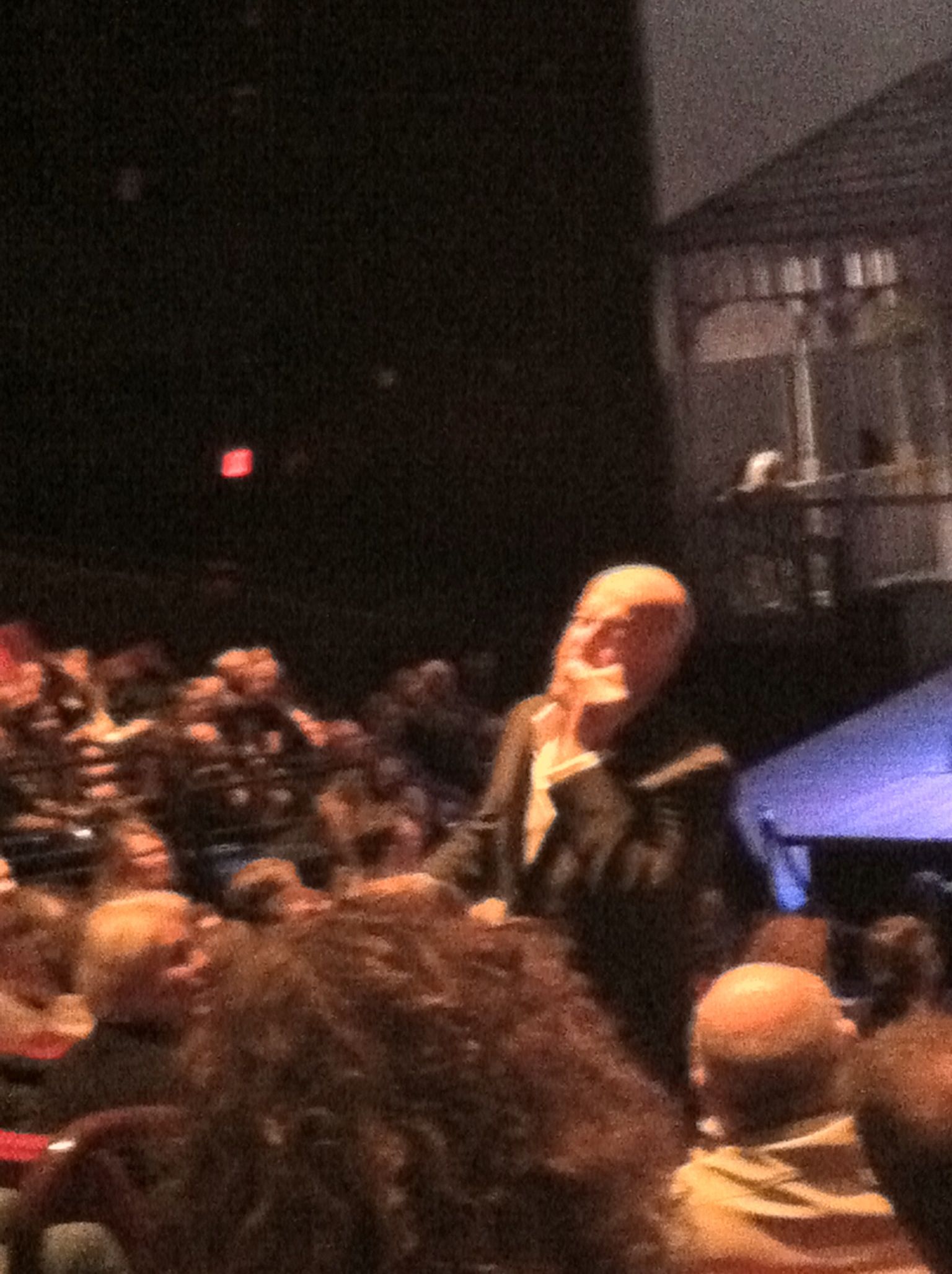
Kim Wilson takes a stroll
Wilson and the T’birds closed out the first half of the program with another short set, bringing unannounced newcomer Jeremy Johnson onstage to join them on guitar. Wilson took the spotlight on Sonny Boy Williamson’s “Early In The Morning,” with his unmiked stroll halfway up the center aisle of the Guthrie, tweeting the high notes on his blues harp all the way. As if that piece of showmanship wasn’t enough, Wilson engaged in an insufferably long, self-indulgent harp workout on the final song of the first half, sending the band offstage for what seemed like an eternity before bringing them back to wrap things up. A famous man – it was either Karl Marx or Mr. Rogers – once said, “Sharing is caring.” While we’re all in awe of your prowess on the mouth harp, Mr. Wilson, there is such a thing as too much of a good thing.
Following the break, Wilson & the T’birds were back to open the second half of the show, starting with Howlin’ Wolf’s “You’ll Be Mine,” and including Eddie Boyd’s chestnut, “Five Long Years,” with Wilson once again taking center stage on the chromatic harp. T’bird guitarist Mike Keller got in a nice solo on the Wolf’s “Riding With Daddy,” to finish off the set, before bringing out the special guests.
First up was 78-year old Jody Williams, an obscure but important figure in blues history, who, as a teenage guitarist, was part of the 1954 recording sessions that produced such Howlin’ Wolf classics as “Evil (Is Goin’ On)” and “Forty-Four.” Mr. Williams took the stage carefully, as befits a man his age, and seated himself stage right, where he played an unnamed double-shuffle instrumental, before switching to familiar songs associated with The Wolf: “How Many More Years” and the Willie Dixon-authored “Spoonful.” As befits a musician more accustomed to the studio than the stage, Mr. Williams seemed uncomfortable in performance, and his guitar playing was tentative, causing the T’birds to adjust the tempo of the song on the fly to stay in sync. Still, he received a rousing ovation when he finished his short set.
By contrast, blues harp pioneer James Cotton was full of personality when it came his turn to take the stage. Mr. Cotton was the third of Muddy Waters’ harp players, after Little Walter and Big Walter Horton, and he has recorded and led his own band ever since Muddy’s death. Touring regularly, despite his advanced age and arthritic knees, Mr. Cotton is outgoing and engaging onstage, with a harp style that’s long on power, at the expense of finesse. He was smiling and playful and clearly seemed to be enjoying himself. In deference to Mr. Cotton’s status, Kim Wilson actually left the stage briefly, allowing the old master to have the harp spotlight all to himself. Wilson rejoined the festivities for a nifty trio workout, with Messrs. Cotton and Margolin, on Son House’s “I Got A Letter This Morning.” The evening ended with everybody back onstage for an extended version of Muddy’s signature tune, “Got My Mojo Workin’,” with Cotton and Wilson – mentor and mentoree – engaging in a playful harp dialogue.
With the show clocking in at roughly two hours, excluding the break between sets, it was certainly a solid evening’s worth of entertainment. Still, it left one questioning the balance of time between the artists. Was it really necessary for Wilson and the T’birds to have opened the second half of the evening by themselves? Why couldn’t Messrs. Ellis and/or Margolin have joined them right away? It seems a shame to have had these two formidable bluesmen out on stage for only their brief 15-20 minute sets, plus the final group number. And, while it is understandable to not want to overtax the senior citizens, the world would benefit from more exposure to Messrs. Cotton and Williams, who are some of the last links to the founding fathers of the blues. Perhaps when it’s time to put together Blues at the Crossroads 3, the producers will consider dividing up the stage time more equally among the performers. Until then, we can at least thank them for putting together these tours, which celebrate the historical antecedents of this most fundamentally American music form.

 seeyouattherockshow