

Charlie Maguire, Tony Glover, Pop Wagner
Woody Guthrie is the gift that keeps on giving. Twenty-eight years after his death in 1967, his daughter, Nora, approached British folk singer/rabble-rouser Billy Bragg, with the idea of having him put to music some of Woody’s unpublished lyrics. The resulting collaboration yielded two splendid compilations, “Mermaid Avenue” (1998), and “Mermaid Avenue: Volume 2,” (2000), with Wilco backing Billy on both releases. A similar project, this time with a quartet of indie rock notables calling themselves “New Multitudes” (Jay Farrar, Will Johnson, Anders Parker and Yim Yames) produced another collection of new music set to Woody’s lyrics, in 2012. Recently, a manuscript that Woody wrote, entitled “House Of Earth,” was discovered by Douglas Brinkley at the University of Tulsa, and published this year to glowing reviews. What’s next, Woody? A screenplay? Oh, wait! That’s already been done (his earlier novel, “Bound For Glory,” was made into a movie in 1976).
The publication of the new novel was the impetus for a celebration of Woody Guthrie’s music at the Gingko Coffee House, featuring a trio of well-known, well-traveled Twin Cities musicians. Charlie Maguire is closely identified with the state and national park service, having been appointed the official “Centennial Troubadour” for the Minnesota State Parks in 1991, a title he still holds. In the ensuing months, he traveled to all of the MN state parks, composing songs and conducting interpretive events to educate campers and visitors about the parks, in word and song. Stepping up to the big stage, Charlie became “The Singing Ranger” for the National Park Service from 1995 – 2003, writing and performing across the country.
Pop Wagner is a walrus-mustached, Stetson-wearing singing cowboy, in the tradition of Roy Rogers and Gene Autry. A popular and frequent performer at festivals, clubs, coffee houses and dance halls, Pop is a talented finger-picking guitar player and fiddler. And, like the cowboys he emulates, he knows the business end of a lasso.
We could – and probably should – write an entire post about Tony Glover. As one-third of the legendary Koerner, Ray & Glover trio, he was part of the folk music revival of the early 60’s. It’s hard to believe, but KRG’s seminal debut album, “Blues, Rags & Hollers,” will be 50 years old this year. Tony has literally written the book on how to play blues harp, and has played at festivals from Vancouver to Newport, with folks as diverse as J.J. Cale and John Lee Hooker. A gifted writer, his liner notes have graced many an album, including, most notably, the multi-page booklet for 1972’s “Duane Allman: An Anthology.”
Together, these three have been playing regular gigs on and around Woody Guthrie’s July 14 birthday, evoking the sound of the Woody Guthrie – Cisco Houston – Sonny Terry trio of the 1940’s. This special event, coinciding with the release of Woody’s novel, drew a full house to the comfortable little coffee shop on the corner of University and Minnehaha in St. Paul on what turned out to be an important date in Woody Guthrie’s history.
The performers were loose and engaging, yet focused and in synch when playing. “Baltimore to Washington” was the show opener, with Charlie handling lead vocals in his strong tenor voice, while Pop and Tony took turns soloing. Pop’s finger-picking leads weren’t flashy, but were entirely in the moment. After all, this IS Woody Guthrie we’re talking about, not Led Zeppelin!
All three took turns reading from “House Of Earth,” throughout the evening,choosing passages that fit the songs. Charlie’s choice, for example, was an excerpt in which the protagonist talks about bringing electricity to the Texas Panhandle, which led into “End Of The Line,” with Pop switching from guitar to fiddle.
Charlie Maguire was a wealth of information about Woody throughout the evening, noting that Woody wrote “around 3,000 lyrics, but only recorded 250!” This factoid came by way of introduction to a song of Woody’s that Pop Wagner had put to music – a la Billy Bragg and The New Multitudes – a humorous ditty about the misadventures of navigating the New York City subway system. Before playing “Oklahoma Hills,” Charlie related an anecdote about Woody’s cousin, Jack, having taken credit for writing the song, before he and Pop traded verses and brought the audience into the singalong chorus.

- “I ain’t got no home in this world anymore.”
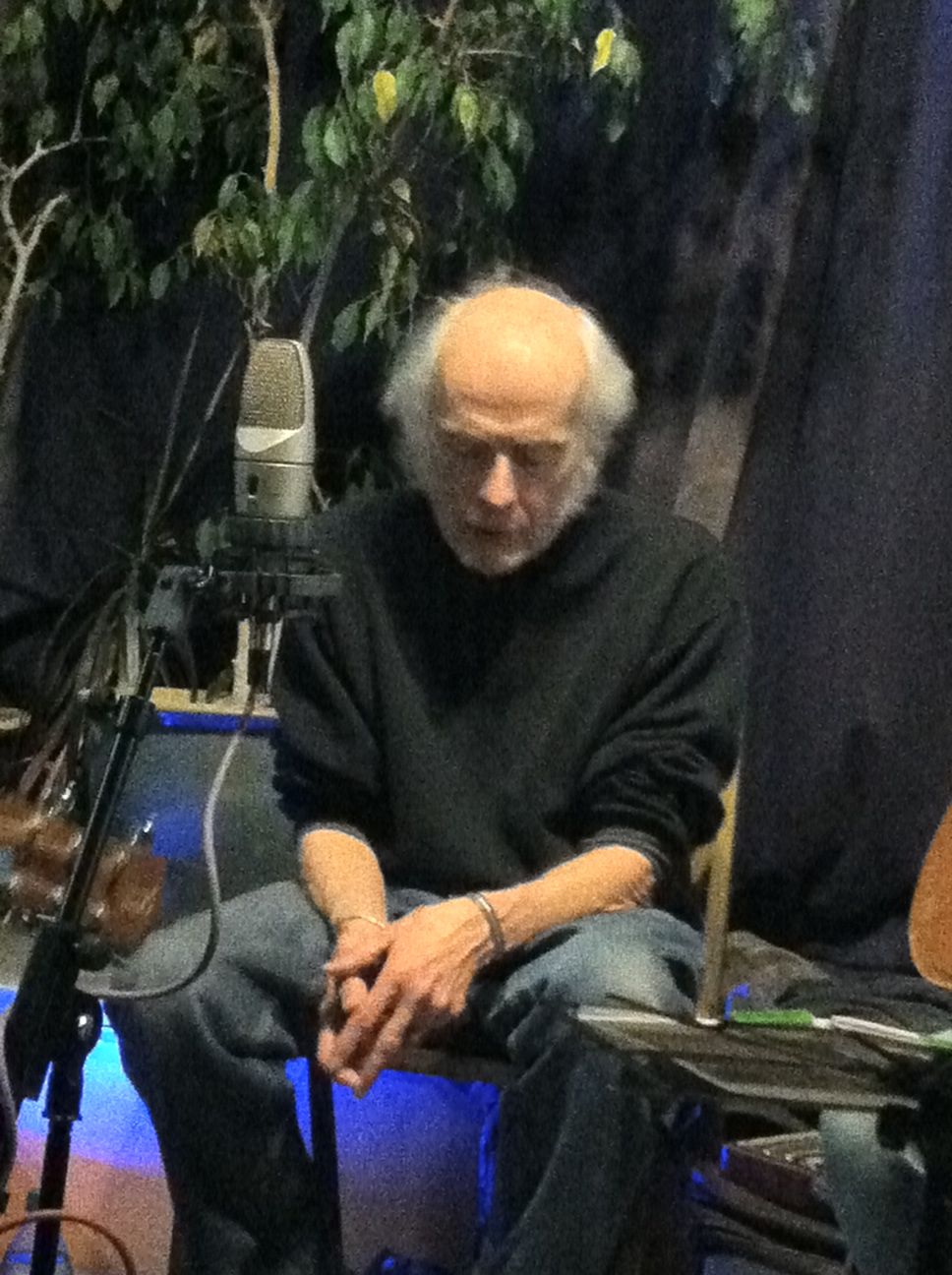
Tony Glover is a man of few words onstage, but he made a crack about the steamy opening pages of Woody’s novel being “D. H. Lawrence stuff,” before reading a less raunchy excerpt from the book, about having a place of one’s own. Tony rarely sings, but his rendering of “I Ain’t Got No Home” was suitably spare, mournful and plaintive.
“Pretty Boy Floyd” was rendered a cappella, for the most part, with Charlie and Pop setting their guitars aside, leaving just Tony’s harp for accompaniment. That was followed by “Talking Dust Bowl Blues,” with sleepy-eyed Pop Wagner handling the lead vocal duties.
From there, it was time for another history lesson – or two. Charlie noted that the date of this show, February 23, marked the 73rd anniversary of the most famous song Woody wrote. “But, this is the song he wrote next!” Charlie commented, by way of introducing a rollicking version of “The Government Road.” “Woody wrote 26 songs in 27 days,” Charlie pointed out, “after being awarded the contract by the U.S. government to write songs for the Columbia River Project.” And, in an interesting historical coincidence, the day he was awarded the contract was the day Bob Dylan was born, in a Duluth hospital. You could look it up – and, apparently, Charlie did!
“Roll Columbia” led to “Hard Travelin'” before another reading, this time by Pop Wagner, about putting down roots. Again, Tony made a sharp, incisive comment, querying whether perhaps Woody was trying to one up another populist writer, John Steinbeck. “New Found Land,” was quite apropos as the follow-up song to that excerpt.
The slightly naughty “Wild Hog Song,” was the final offering before THE BIG ONE: “This Land Is Your Land,” which, we were told, was written 73 years ago this very day! The popular version taught in schools leaves out the more subversive verses (such as: “Was a high wall there that tried to stop me / A sign was painted, said: ‘Private Property’ / But on the back side it didn’t say nothing / That side was made for you and me”). We all sang along with the chorus gleefully, as well as the encore of “Roll On Columbia” before the old boys called it a night.
It seems fitting, in a way, that Woody’s birthday falls on Bastille Day, the day that commemorates the beginning of the French Revolution. Granted, it would have been more appropriate had it fallen on our own Independence Day, but either way there’s a connection to be made between the man whose guitar bore the slogan “This machine kills Fascists,” and a popular revolution that led to the overthrow of a tyrannical government. Charlie, Pop and Tony will be celebrating the old left-wing folk hero’s birthday with an evening of song at the Eagles Club in South Minneapolis on July 14. Start making plans to attend now.
 seeyouattherockshow